How reviews work
Code Voucher records reviews for GitLab merge requests and GitHub pull requests. Review work runs asynchronously, with durable state for retries, worker restarts, and duplicate events.
Find your way around
- Review and run
- Reviews lists the code reviews in your workspace. A run is one recorded execution for a specific change and commit.
- Findings and verification
- Findings explain problems in the reviewed change. Verification explains which checks ran and what remains untested.
- Runtime QA (Agentic QA)
- Runtime QA tests the running application in a browser. A QA environment is the isolated application setup those checks use.
- Pipeline and CI bridge
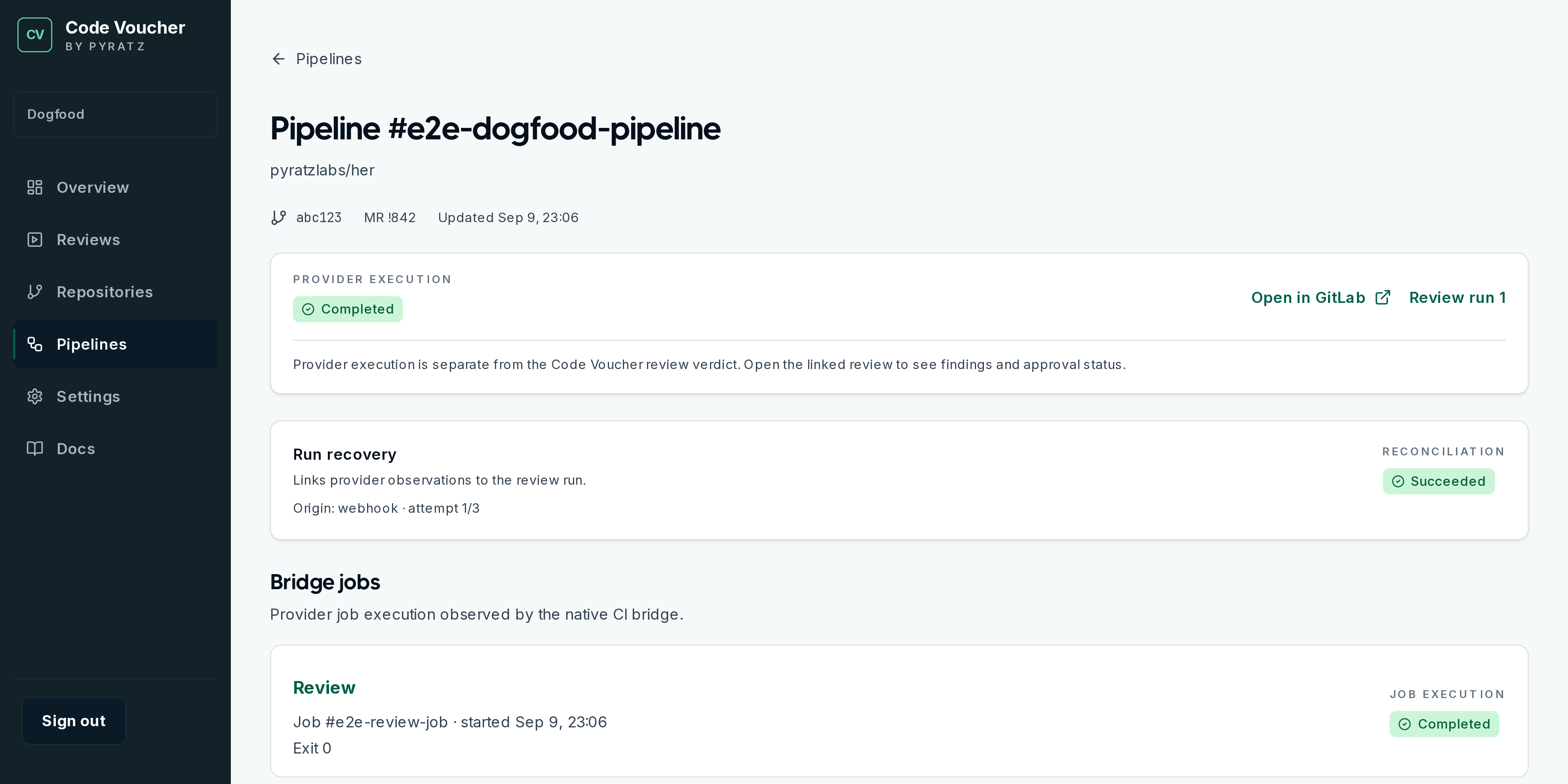
- A pipeline is execution in your code provider. The optional native CI bridge connects provider jobs to a Code Voucher review; its status is separate from the review verdict.
Identity and repository access are separate
Your GitHub or GitLab sign-in establishes your Code Voucher identity and organization membership. Repository access is connected separately through the workspace's GitLab service account or GitHub App installation. Those connections determine repository access; publication requires its own policy and capability checks. Signing in alone does not connect repositories or authorize provider writes.
Run lifecycle
Durable state separates short web requests, untrusted execution, and trusted publication. A deploy or duplicate event can resume the same run instead of starting an untracked second workflow.
1 · Ingress
Webhook creates a run
A signed provider event is normalized, persisted, and queued.
2 · Analysis
Review challenges the diff
Trusted validation decides which model observations affect the verdict.
3 · Execution
QA follows approval
Route smoke and deterministic scenarios run in bounded browser contexts.
4 · Publication
Publisher reports
Private evidence stays in the dashboard; providers receive classified summaries.
Follow the review as it runs
Reviews with recorded phase evidence show Exploration, Adversarial review, and Code quality above the findings. The current phase updates automatically, with elapsed time and retry information. On small screens, expand Show phase details to see the whole sequence.
Exploration may be unavailable while the remaining review continues with limited context. A completed phase means execution finished; its findings can still request changes. Completed reviews collapse into a summary so the findings stay prominent. Older reviews without phase evidence keep their existing review summary.
Native CI, private detail
The pipeline remains the merge gate engineers already use. The dashboard is the evidence system for findings, screenshots, rejected observations, retries, failure reasons, and the preserved scope, verification, depth, and residual risk from each independent review pass. Clean approvals retain the full review report instead of collapsing to a verdict alone.