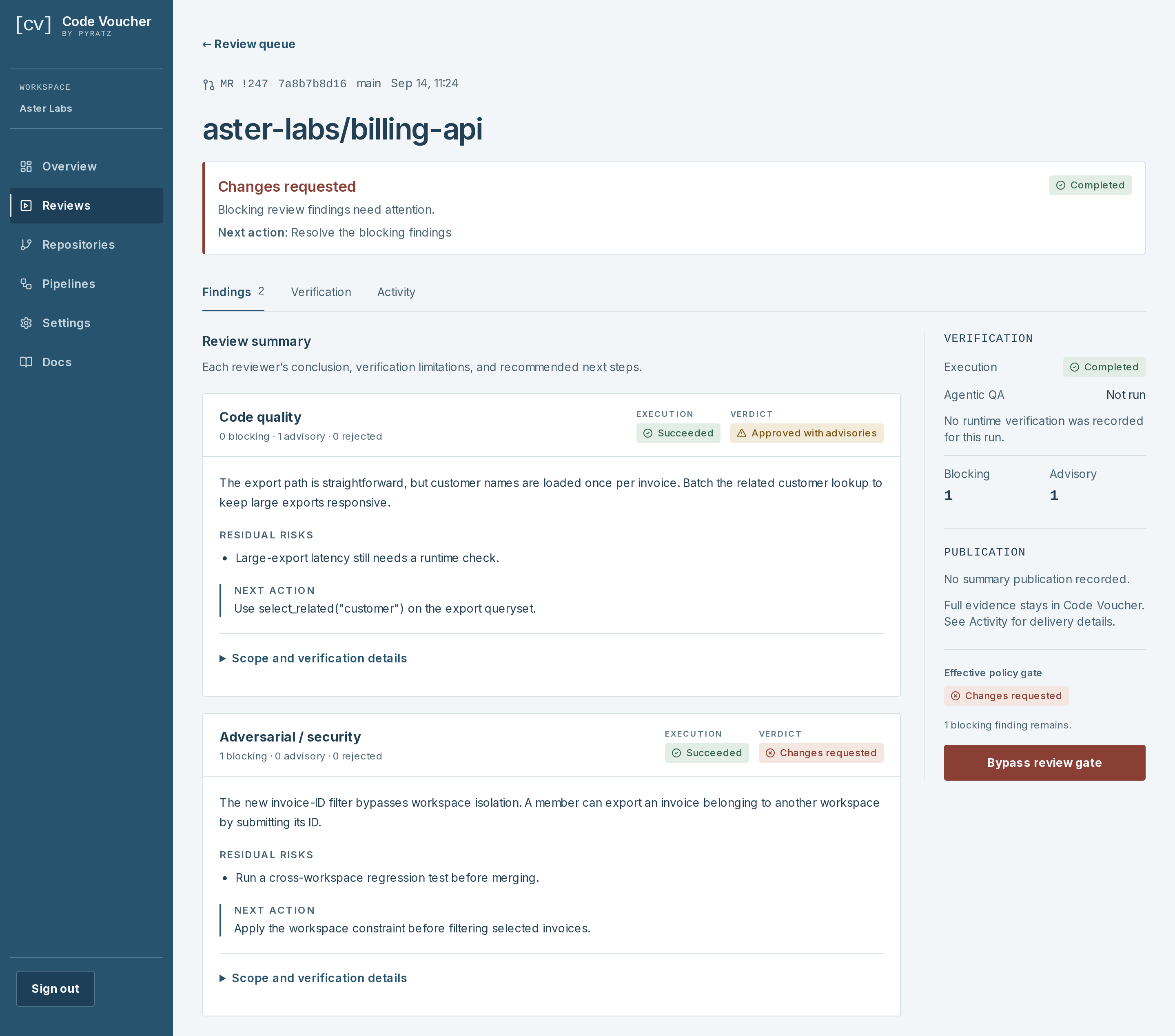
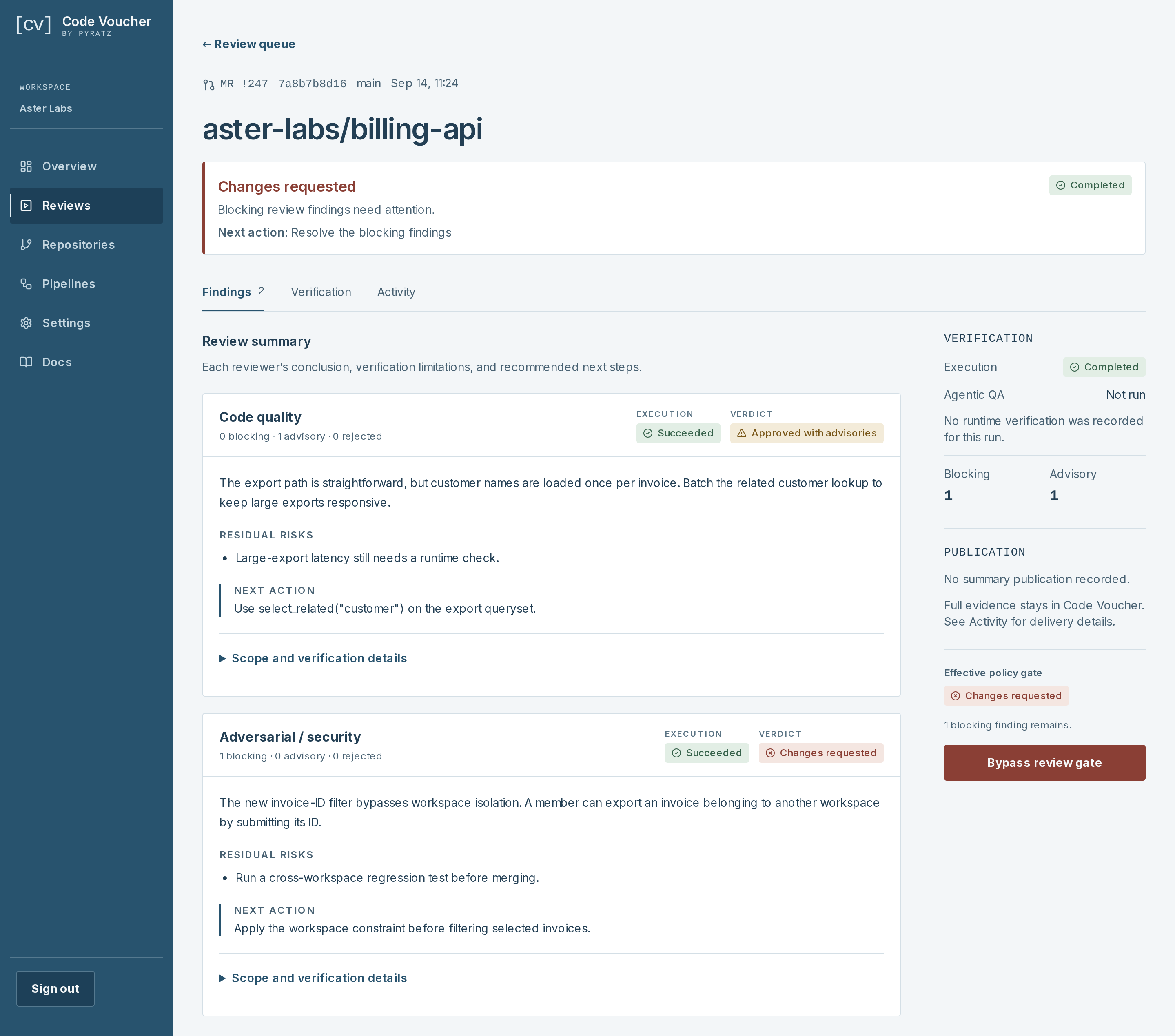
Catch the issue. See why it matters. Inspect the fix.Code Voucher by Pyratz reviews every round of your GitLab merge requests and GitHub pull requests for security and code-quality issues, with private findings, evidence, and no per-review fees.
Sign up with GitLab or GitHub, create your workspace, and connect your repositories. Your new workspace starts a 14-day free trial with 5 developer seats. Open a merge request or pull request and start reviewing security and code-quality findings with your team.
No card is required to try it. Continue with Pro at $15 USD per developer per month and add paid seats as your team grows. Manage your subscription and seats from workspace settings.
Agents open more merge requests and push more revisions than a team can read line by line. Code Voucher reviews every round, at a flat price per developer.
[a] Agent-speed review
Every round, reviewed.
Each push and requested re-review gets its own review. No per-review fees. Hosted AI includes 5 review runs per developer per hour; on your own Codex, Code Voucher sets no review cap.
For comparison, CodeRabbit plans include 5, 8, 10 or 12 PR reviews per developer each hour; continued reviews cost $0.25 per reviewed file. Source: CodeRabbit pricing ↗
[b] Bring your own Codex
Reviews run on the plan you already pay for.
Connect your team’s existing ChatGPT/Codex subscription: no per-review fees and no review caps from Code Voucher. Your own Codex plan limits and terms still apply. Hosted AI is included if you’d rather not connect one.
Run Code Voucher on your own servers with Docker Compose, on a standard Django, Postgres, Redis, Celery and Next.js stack. Self-hosting is free; paid support is available. Model calls still go to the model provider you choose.
CodeRabbit offers self-hosting to Enterprise customers with 500 or more seats. Source: CodeRabbit docs ↗
Follow callers, imports, and surrounding code. Deep review investigates beyond the changed lines, then checks the candidate findings in a separate verification phase.
DEEP REVIEW / how it works
Illustrative investigation
Context plan / example paths
READING ORDER3 PRIORITY PATHS
01
Changed filebilling/invoices.py
Tenant filter removed from the lookup.
Start here
02
Incoming callerapi/invoices.py
Trace the organization supplied by the request.
Follow next
03
Outgoing importbilling/models.py
Check whether the model scopes the query.
Inspect boundary
Suggested starting points. Full snapshots remain available.
The context plan prioritizes changed files, outgoing imports, and incoming callers for investigation.
ADVISORY BY DESIGN
More leads to investigate. A separate report. Deep-review findings never block your merge.
See how a finding becomes a proposed fix →Opt in for eligible repositories. Broader discovery can produce more false positives; standard review remains the merge-gating review.
03 / Auto-fix, with a clear handoff
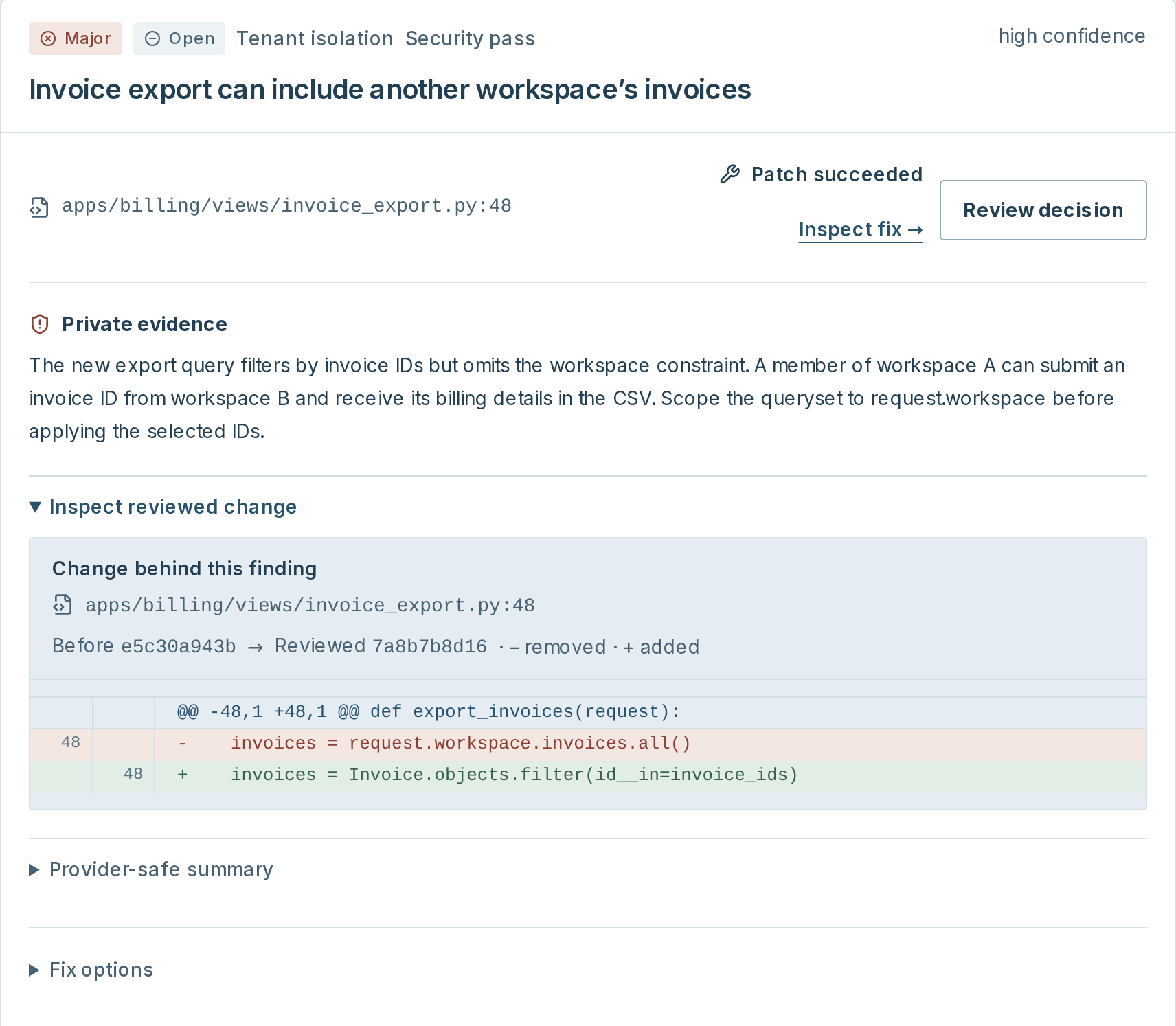
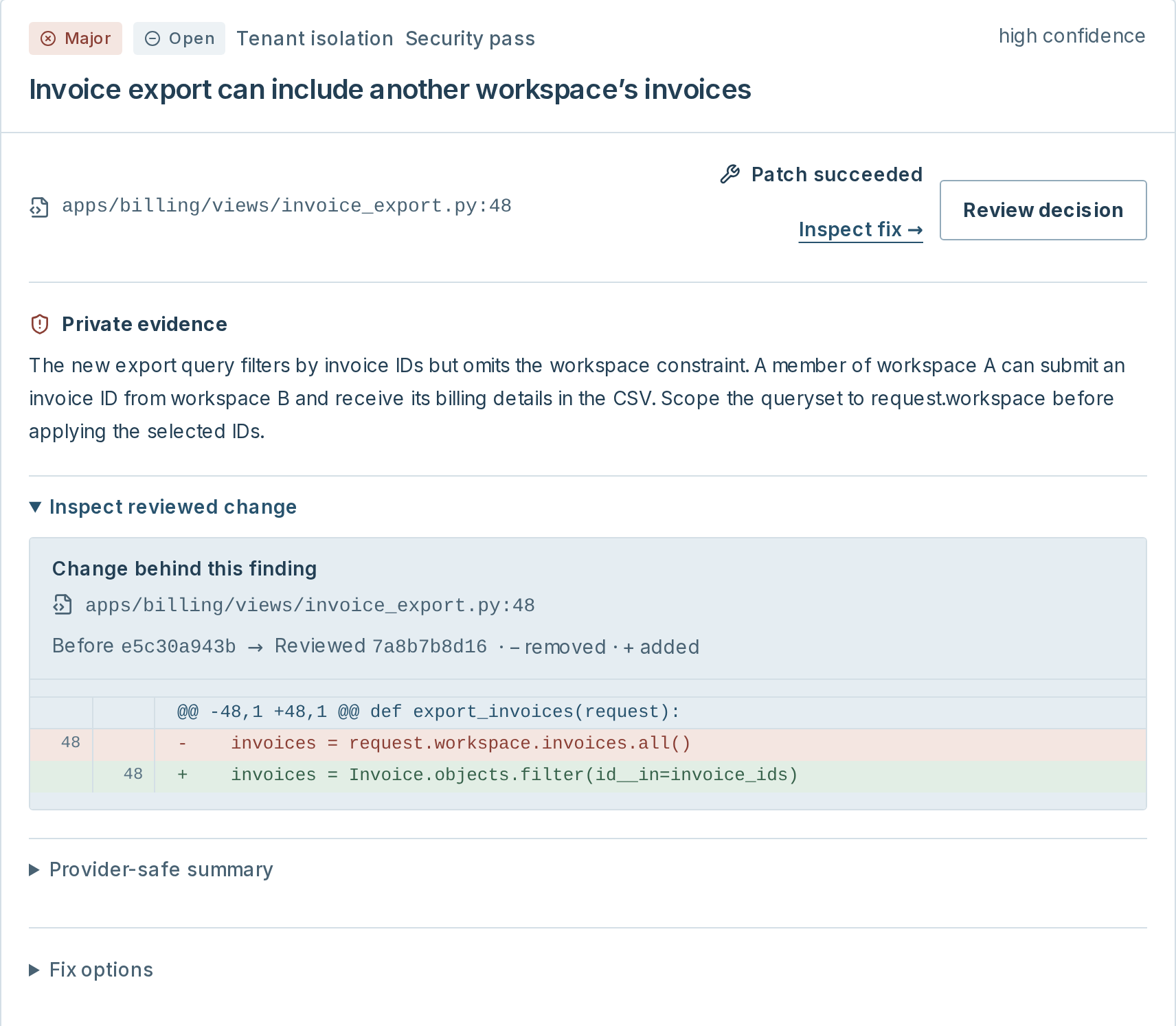
Found it? Move straight to the fix.
Scope the change. Inspect the proposal. See what was checked. Keep the decision to ship in your hands.
01 Scope the fix→02 Generate a patch→03 Inspect checks→04 You decide
billing-service / proposal #12
Illustrative workflow
Proposed fix
Restore the tenant boundary.
Limit the invoice lookup to the current organization. Keep the change focused on the finding.
Scope
1 lookup · 1 regression test
Decision
Awaiting your review
Example proposal and checks. No code is executed in this demo.
Evidence ready for inspection. Your review is the next step.
Illustrative results for this concept. A live proposal would link to its actual test evidence.
Explore the intended end-to-end experience. Verification shown here is illustrative.Open your workspace →
04 / Built around your team
Your standards. A consistent second look.
Security and code-quality reviews for GitLab merge requests and GitHub pull requests. See what needs attention, what was verified, and what your team should do next. Explore review scope, audits, and fixes
[cv]Review platformCode Voucher hosted platformDashboard · orchestration · review data
↔Separate data boundaries
Your infrastructure / planned
>_Review agentsYour infrastructure · your runnerExecution in your environment
Your infrastructure / self-hosted
[cv]Review platformYour dashboard & orchestrationDashboard · orchestration · review data
↔
>_Review agentsYour infrastructure · your agentsIsolated review execution
↕
Your configured model connection
MODEL PROVIDERYour key or supported subscriptionModel requests follow the selected provider’s data boundary.
Get started with the hosted platform.
Connect a repository and use hosted execution. Bring your own API key or supported subscription.
Bring execution into your environment.
Planned: register your own runners while keeping the hosted dashboard. The platform and runner have separate data boundaries; this does not make the whole service self-hosted.
Run the platform on your terms.
Free today: run the platform and review data on your own servers with Docker Compose; paid support is available. Model requests still go to your selected provider under its data policy.
06 / Bring the AI you already use
A new review workflow. Your existing AI account.
Bring your own key or supported subscription. Keep the model relationship you already have, and make it useful across your reviews. Your own plan limits and terms still apply. How connecting your subscription works
CONNECTION WALKTHROUGH
Connection preview / illustrative
>_Provider API keyCONFIGURATION PREVIEW
provider
your model provider
credential
•••• •••• ••••
purpose
review execution
billing
your provider account
EXAMPLE ONLY / NO CREDENTIALS COLLECTED
Your model usage is billed through your provider. This example does not collect credentials.
Supported subscription
01
Choose an eligible provider
Check support for your subscription.
02
Account authorization
Authorize through the provider’s supported flow.
03
Return to your reviews
Review execution uses the authorized connection.
Use an eligible subscription connection. Provider support and subscription limits apply. This is an illustrative connection preview.
Further ahead / product direction
Choose the depth. Set the budget.
Per-repository spending, model choices, and review limits—so more automation comes with clearer costs.
07 / Open-source release planned
Look under the hood. Make it yours.
Review infrastructure deserves to be inspectable. We want teams to understand the system, extend it, and keep their options open.
Self-hosting is free today; the open-source release is being shaped.
Inside Code Voucher / architecture sketch
[/]Review orchestrationHow work moves from stage to stage
[/]Agent executionWhere investigation happens
[/]Findings & evidenceWhat the reviewer found, and why
[/]Patch proposalsHow the next change takes shape
Back to the work that needs you
Give your next change a second look.
Sign up, create your workspace, and connect GitLab or GitHub. Start your free trial and give your next merge request or pull request a focused security and code-quality review.
 GitLab
 GitHub